Current article

How HealthHelper helped improve HEDIS measures by as much as 31%

How HealthHelper helped improve HEDIS measures by as much as 31%

How HealthHelper helped improve HEDIS measures by as much as 31%

Yes, you read that right! A study finds that a Boston area practice, Family Practice Group, improved its HEDIS measure care gap metrics by as much as 31% by partnering with HealthHelper. But wait...there's more! The improvement came virtually with no extra effort by the practice staff, which is incredibly important given the current state of primary care in the US.

"HealthHelper is filling a real gap for us and taking a tremendous amount of work off our plate. Their combination of technology and services helps us improve contract performance, optimize provider schedules, and improve clinical quality. Our patients, providers, and staff all love it!"

-Dr. Laura Zucker, Lead Primary Care Physician at Family Practice Group.

Let’s jump straight into the results. The study revealed that in 2022 HealthHelper scheduled 1,164 appointments for Family Practice Group. Leveraging proprietary multi-modal drip campaigns, HealthHelper scheduled 43% of the patients who were contacted. And, the scheduling was completed in a highly scalable and consumer-centric fashion, with 71% of those appointments being scheduled entirely via HealthHelper's texting automation.
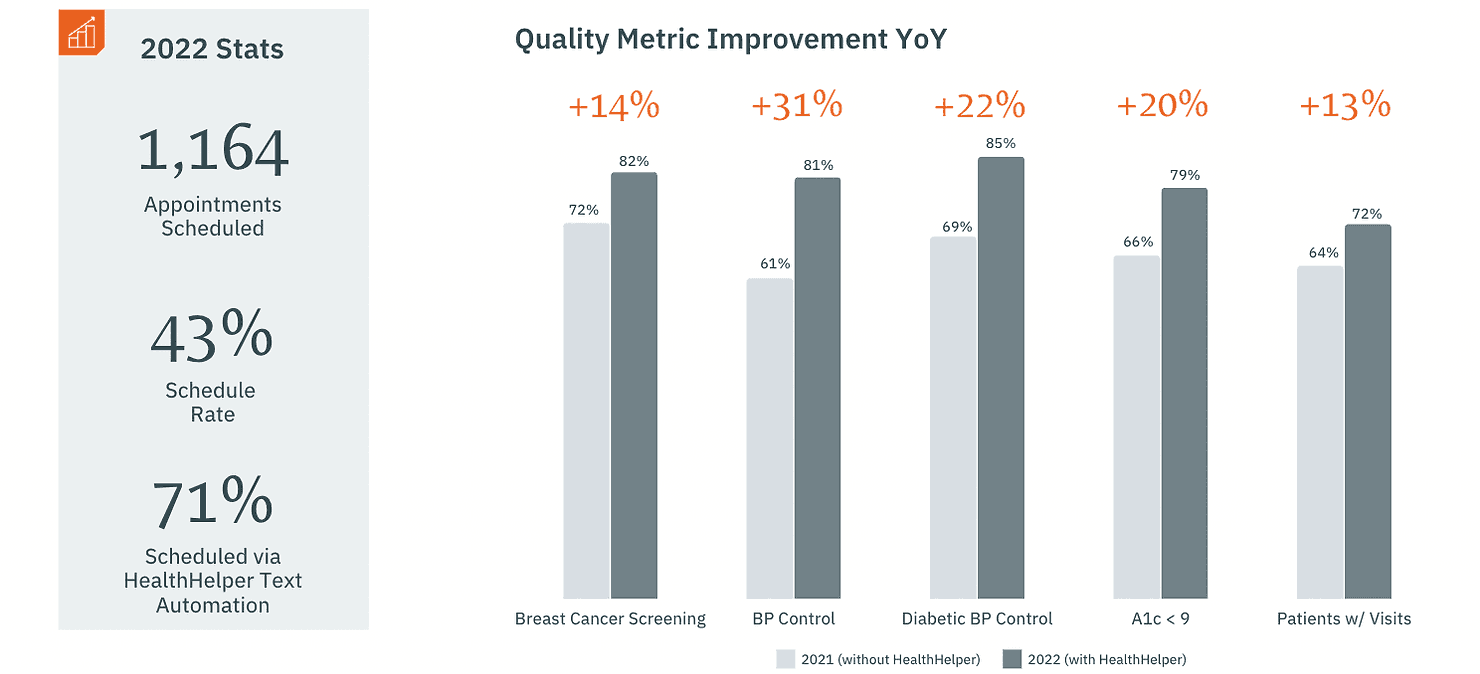
Bar Chart of Quality Metric Improvement YoY

More importantly, the improvements in HEDIS quality metrics were significant and included both process and outcome measures. The practice experienced the following improvements from partnering with HealthHelper:

  • Breast cancer screening rates increased from 72 to 82 percent

  • Blood pressure control (<140/90 mm Hg) rates rose from 61 to 81 percent

  • Diabetic blood pressure control (<140/90 mm Hg) rates improved from 69 to 85 percent

  • A1C control (< 9%) improved from 66 to 79 percent

  • Attributed patients with visits increased from 64 to 72 percent

The results of the study conducted with Family Practice Group show that HealthHelper had a significant positive impact on patient outcomes. Moreover, the improvement in diabetic blood pressure control rates and A1C levels are both notable as they exceed the national average for adults with diabetes, which is 52.5% for blood pressure control and 45.8% for A1C control, as reported by the CDC. The increase in blood pressure control rates from 61% to 81% is also significant, considering that the national average for adults with hypertension is 45.7% and only 1 in 4 of those adults have their condition under control, according to the CDC.

The results of the study also show an improvement in process measures, an important component of high-quality preventive care. The increase in breast cancer screening rates from 72% to 82% is noteworthy, as it exceeds the national average of 72.4% for women aged 50-74, as reported by the Centers for Disease Control and Prevention (CDC).

Additionally, the increase in the number of attributed patients with visits from 64% to 72% is a positive sign, as it helps practices improve preventive care and the accuracy of their risk coding - which is such an important ingredient in value based care success.

Overall, the results of the study demonstrate the effectiveness of HealthHelper in improving patient outcomes, increasing patient engagement, and driving practice success.

So... how'd we do it?

HealthHelper drove these improvements through a technology-enabled service that offloaded practice staff of tedious panel management work. We acted as an extension of Family Practice Group's staff, working directly in their EHR augmented by our Panel Management Platform's scalable and automated workflows.

We began to schedule patients and deliver results in a matter of weeks, demonstrating a quick and easy onboarding process. Our Panel Management Platform ingested patient data from various sources, which included the EHR and population health tool. Then, via our proprietary algorithm and advanced data analytics, we prioritized patients for outreach. Our team of experts conducted chart reviews to confirm and validate the care gaps and the need for outreach in order to reduce patient friction from inaccurate outreach. Once confirmed, we placed patients onto our automated Care Outreach Drip Campaigns, which include a proprietary sequence of text messages, phone calls, and emails to directly schedule high-value appointments at the practice and close gaps in care outside of the office.

Furthermore, we're able to reach out to underserved populations as the technology allows for outreach in languages other than English. Statistics about the patient panel and outreach results are available in real-time via analytics dashboards. And lastly, to stay in lock step with the practice, we held regular meetings to adjust patient prioritization algorithms and outreach based on the needs of the practice at that particular time, which may include patient attribution, dormant patients, group visits, provider departure, and much more.

Would you like to learn more? Schedule a 30-minute conversation via this Calendly link.

HEDIS measures

References

You may like these too

5 AI Solutions Eligible for Rural Health Transformation Program (RHTP) Funding

As states roll out Rural Health Transformation Program (RHTP) funding, FQHCs are facing a practical question: What AI technology can we implement that will deliver measurable value for our health center while qualifying for RHTP funding?

HealthHelper offers a suite of AI-powered solutions that align with RHTP priorities by improving patient access, strengthening care coordination, and supporting sustainable care transformation.

Key Takeaways

  • Five purpose-built AI modules cover access, chronic disease outreach, care gap closure, post-discharge follow-up, and referral coordination.

  • Modules priced on usage and value creation, not a flat license fee.

  • No new hardware, EHR overhaul, or lengthy IT project is required to get started.

  • Each module generates structured outcomes data suited to RHTP goals.


Call Helper

An AI voice agent that expands patient access.

Call Helper answers overflow, after-hours, and unanswered calls, resolves routine scheduling and administrative requests, and routes more complex needs to the appropriate staff member or queue. It increases call capacity while reducing call center and front-desk workload—without adding headcount.


Visit Helper

Proactive, data-driven outreach that improves care plan adherence and patient access.

Visit Helper identifies patients who are due or overdue for care, engages them through text messages and phone calls, and schedules appointments directly within your existing workflow. It's designed for panel management, preventive care, and chronic disease follow-up.


Care Gap Helper

Improves quality performance through care coordination and care gap closure.

Care Gap Helper combines EHR, payer, and quality data to identify and prioritize patients who are overdue for screenings, lab work, immunizations, and chronic disease management. It then coordinates the appointments and services needed to close those gaps, helping organizations improve quality metrics and value-based care performance.


Transitions Helper

Reduces avoidable readmissions and supports Transitional Care Management (TCM) revenue capture.

Transitions Helper ingests hospital and emergency department discharge data, prioritizes patient outreach, schedules timely follow-up appointments, and screens patients for additional needs following a care transition.


Referral Helper

Closes referral loops and improves access to specialty care.

Referral Helper tracks outbound referrals from the time an order or authorization is placed, verifies whether specialty appointments are scheduled, helps patients overcome scheduling barriers, and ensures completed consult notes and results make their way back to the primary care practice.

Why It Matters for RHTP Applications

These solutions, supported through RHTP funding, present a unique opportunity to fund sustainable health center transformation. FQHCs can start with the one or two modules that align most closely with their state's highest-priority RHTP initiatives, then expand over time as funding grows and outcomes data demonstrates success.

Frequently Asked Questions

How long does it take to launch a module?

Most FQHCs can begin engaging patients or routing calls within a few weeks of onboarding.

Do we need to replace our EHR or phone system?

No. HealthHelper is designed to work alongside existing systems rather than replace them.

Can we start with just one module?

Yes. Most FQHCs start with the module tied to their most urgent operational or funding priority and add others over time.

RHTP Funding Is Live: What FQHCs Need to Know Before They Apply

Key takeaways

  • RHTP makes $50 billion available to states over five years for rural healthcare transformation.

  • States are required to show measurable progress against clinical and operational outcomes to keep receiving funds.

  • AI-enabled remote care and coordination tools have already been named as an eligible use of funds in published state guidance.

  • FQHCs are explicitly recognized as eligible applicants, partners, and subrecipients.

  • Programs that can launch quickly and report outcomes early are best positioned to compete for funding.

The Rural Health Transformation Program is now moving from announcement to action. States have begun releasing their transformation plans and, in some cases, their own funding notices for local providers, and the window for FQHCs to position themselves is open now rather than later.

Most published guidance points to the same three clinical objectives: reducing avoidable hospital utilization, improving chronic disease management, and strengthening care coordination. Applicants who can show a clear, near-term path to those outcomes tend to score better than those proposing broad, undefined initiatives.

One detail worth flagging for FQHCs: AI-enabled care coordination technology has already been called out as an explicitly eligible use of RHTP dollars in at least one state's funding notice. That's a meaningful signal for organizations weighing whether a technology investment fits within program guidelines.

How HealthHelper Supports RHTP-Aligned Programs 

HealthHelper's suite of AI modules, Call Helper, Visit Helper, Care Gap Helper, Transitions Helper, and Referral Helper, was built to generate exactly the kind of outcomes data RHTP applications and ongoing reporting require. Because each module is priced on usage rather than a large upfront license, FQHCs can deploy them quickly and start building a reportable outcomes record without waiting on a lengthy procurement cycle.

If your organization is preparing an application or has already been awarded funding, now is the time to line up the technology that will let you prove impact from day one.

What Is the Rural Health Transformation Program? An Overview for FQHCs

Rural and community-based providers have spent years managing the same structural problems: too few clinicians, aging infrastructure, patients who travel long distances for basic care, and razor-thin margins that leave no room for error. The Rural Health Transformation Program (RHTP) was created to help states address these problems by transforming rural healthcare delivery.

What Is RHTP? 

RHTP is a federal initiative, authorized through the One Big Beautiful Bill Act, that directs $50 billion in funding to states over five years (FY2026 through FY2030) to redesign and strengthen rural healthcare delivery. The Centers for Medicare & Medicaid Services (CMS) administers the program, but each state designs and submits its own transformation plan describing how it will use the money to improve access, provider sustainability, and care quality for rural populations.

How the Funding Works 

Funding is distributed in two ways: half is split evenly among approved states, and half is awarded competitively based on factors like degree of rurality, existing state policy support, and the ambition and quality of the proposed plan. States are expected to meet implementation milestones, report outcomes, and demonstrate progress throughout the five-year program. CMS retains oversight and may reduce or withhold funding if program requirements are not met.

Where the Money Tends to Go 

Because states retain flexibility in how they structure their programs, priorities vary, but a common set of themes shows up across almost every plan:

  • Stabilizing rural hospitals and clinics

  • Expanding access to primary and behavioral health care

  • Building the rural healthcare workforce

  • Improving chronic disease management and prevention

  • Modernizing technology, data, and care coordination infrastructure

  • Developing innovative payment models and value-based care

Why It Matters for FQHCs 

FQHCs are expected to play an important role in many state transformation plans. That matters, because FQHCs already carry much of the burden of rural primary care, chronic disease management, and care coordination, often with fewer resources than hospitals and health systems have.

Frequently Asked Questions

Who can apply for or participate in RHTP funding? 

Organizations that commonly participate in state RHTP initiatives include FQHCs, rural health clinics, hospitals, independent physician practices, behavioral health providers, public health agencies, and multi-organization partnerships.

Is RHTP funding only for hospitals? 

No. While hospital stabilization is a major focus, plans routinely include clinics, community health centers, workforce programs, and technology initiatives that extend well beyond inpatient settings.

Does technology count as a fundable investment? 

Yes. Technology investments are an important component of many state plans, particularly when they improve access, care coordination, digital health capabilities, operational efficiency, cybersecurity, or measurable health outcomes.

How long does the funding last? 

The program runs through fiscal year 2030, but individual state awards and provider-level funding are typically structured in multi-year, performance-based cycles.

How should FQHCs prepare today?

Although providers do not apply directly to CMS, FQHCs can position themselves by:

  • engaging with their state’s RHTP planning efforts;

  • identifying projects aligned with state priorities;

  • preparing measurable outcomes;

  • evaluating technologies that improve access, care coordination, workforce efficiency, and operational sustainability.

HealthHelper's AI-powered modules, including Call Helper, Visit Helper, Care Gap Helper, Transitions Helper, and Referral Helper, were built around these same fundable priorities. If your FQHC is building an RHTP strategy, a good next step is understanding how each priority area connects to deployable technology you can implement now.

Care New England and Integra Achieve Remarkable Improvements with AI-Powered Care Gap Closure Services from HealthHelper

Care New England and Integra Community Care Network (Integra) embarked on a transformative partnership with HealthHelper, aiming to address care gaps and enhance population health management. In just the first year of the HealthHelper partnership, this collaboration has led to significant advancements in patient retention and quality metrics, underscoring the impact of innovative healthcare solutions.

Achieving Notable Increases in Preventive Screenings and Quality Metrics

Through the integration of HealthHelper’s technology-enabled care gap closure services, Care New England reported substantial improvements in preventive care screenings:

  • Breast Cancer Screenings: 13% increase

  • Colorectal Cancer Screenings: 16% increase

  • Hypertension Screenings: 10% increase

  • Diabetic Eye Exams: 61% increase

  • Diabetic HbA1c Screenings: 29% increase

These enhancements reflect a concerted effort to close care gaps and promote early detection, pivotal components of effective population health management.

Strengthening Patient Retention and Care Coordination

A cornerstone of the partnership’s success is the impressive 88% in-network retention rate for screening mammograms. By ensuring patients receive coordinated care within the Care New England system, the collaboration has fortified patient trust and continuity of care. This strong care coordination helps ensure that patients receive their follow up care while also improving the financial standing of an important healthcare provider to the Rhode Island community.

Financial Impact and Return on Investment

The partnership has also yielded significant financial benefits:

  • Appointments Scheduled: 5,245 across the care continuum in the first year

  • Return on Investment: 3.4x

These outcomes highlight the dual advantage of enhancing patient care while achieving financial sustainability.

Seamless Epic Integration and Provider Workflows

Implemented in under two months, HealthHelper’s solution seamlessly integrated with Care New England’s Epic platform. This swift deployment alleviated administrative burdens, allowing providers to focus on delivering exceptional patient care. One team member remarked, “This is the easiest implementation project I’ve ever had!”

Leadership Endorsement: A Model for Scalable Success

Dr. Ana Tuya-Fulton, President and Chief Operating Officer of Integra and Chief Population Health Officer of Care New England, emphasized the strategic value of the partnership:

“Our partnership with HealthHelper has delivered measurable value for both our health system and our ACO. Their AI-powered Care Gap Closure services have improved performance, driven results, and seamlessly integrated into our workflows.”

Better Population Health with AI-Powered Care Coordination and Care Gap Closure Services

By combining technology-driven automation with high-touch patient engagement, HealthHelper is transforming how healthcare organizations identify, engage, and close care gaps at scale.

To learn more about how HealthHelper’s AI-powered Care Gap Closure services can support your organization, contact Jake Kahane at jake@healthhelper.co. To read more about the partnership between HealthHelper, Care New England, and Integra, check out this post by Care New England.